Synopsis
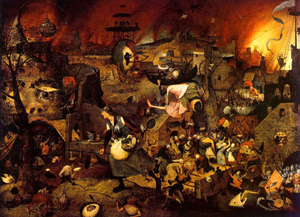
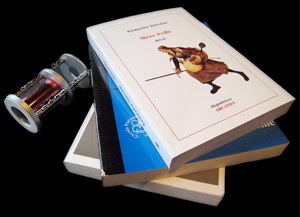
A feature film based on the book Mère Folle from 1998 by the French psychoanalyst Françoise Davoine. Mère Folle is a theoretical fiction, a fictional text that creatively elaborates theoretical thoughts, and stimulates readers to continue thinking. The book has been translated into Finnish and Spanish. The film stages a confrontation between the psychoanalyst and her traumatized patients on the one hand, and between this contemporary world and medieval fools on the other. The importance of the film lies in a positive representation of mad (psychotic) people and of a constructive interaction between mad and sane people through which both learn new things that help them live their lives. Within the film medieval “fools” strike, precisely, that balance. They are not mad but play the fool; yet, how do we know what “being” mad is, and how that being is different from playing? Can you play what you are? The film, like the book, is an out-of-the-box integration of fiction, documentary, and theory.
The story
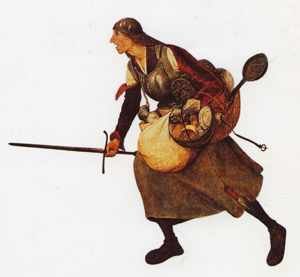
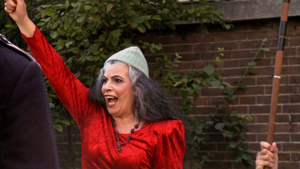
Tomorrow is All Saints Day. In the present, Françoise the narrator just learned of the death by overdose of one of her psychotic patients. Discouraged, she blames herself and blames psychoanalysis for this failure. She is tempted to abandon her job at the psychiatric hospital. While pondering this decision in the courtyard of the hospital, she is suddenly accosted by medieval fools who challenge psychoanalysis as fraudulent. Their primary grievance is the privileging of the word over gesture. But a crisis is harder to actually live than she had thought, and reluctantly she returns to work anyway. There she talks with patients, and slowly the distinction between the fools and the mad fades away. Françoise is struck by the unexpected wisdom both groups bring forth. Exhausted and dejected, she goes back home, parks her car. In her own garage, she is abducted and begins a strange voyage. She is taken to the Middle Ages – or else, the Middles Ages surface in the present, in a small Parisian theatre. She is brought before a court where she is blamed not for the death of her patient but for lack of insight. The episodes of that court case confront her, and us, with the sanity of reasoning hiding behind the fool’s mask. The “fools” come from the tradition of “sotties”, a political theatre from the late Middle Ages, that is a kind of or carnival of fools. These fools merge with the patients at the hospital. As opposed to the patients, the fools have impunity. The narrator’s own literary and philosophical sources, in turn, also mix in during the trial, in the form of imaginary or dreamed dialogues with great thinkers such as Antonin Artaud, Ludwig Wittgenstein, T.S. Eliot, and Friedrich Nietzsche. Clearly, there is madness and madness, and perhaps genius is often not so far away. There is also a carnival of words taking place; hilarious yet incisive dialogues where everyone, fool, mad or sane, past, present, or as in-between as the mad are, is on a equal footing, and the smart repartees are not, by far, always the narrator’s.
Ideas Embodied in the Story
This dialogic traversal of time is for the narrator also a return to her own past. Her boundaries – in time, space, and identity – melt. She becomes capable of identifying not only with her patients, whose adventures she begins to participate in, but also to her former self. Two patients, a woman named Sissi – doctor Davoine’s first failure of twenty years ago, and the timeless elfin Ariste who dies at the beginning of the film and undergoes treatment at the end, constantly confront Françoise with the difficulty of her work and the danger, yet likelihood, of failure. But nothing is entirely positive or negative, success or failure. The two more-or-less failures, with Sissi and with Ariste, traverse the film. From these combined travels she gains a capability to learn and practice immersion into the delirium of her patients, in order to become a fraternal equal. Only through such an extreme identification will she be able to carve for them an auxiliary space wherein the “catastrophic regions” that generated their madness could be confronted. Only through this method, which has profound consequences for the human existence of the psychoanalyst and the way she can even tell her story, can psychosis be cured. All through the story, the narrator has been practicing precisely that: becoming an equal to the “fools” and the “mad.” It is on this hopeful medieval universe of folly, the story ends. Meanwhile, we will have made the acquaintance of a number of patients, who each pull the narrator into their own temporal and spatial catastrophic regions. Theoretical considerations, only happening in the mind of the narrator, will be taken over by fools, colleagues, and patients. In order to avoid an individualistic, autobiographical interpretation of a story that, in fact, harbours important theoretical insights, several levels of dispersal make it more general while preserving the singularity of the characters involved. The film is multilingual; actors from different countries speak their own languages. Physically it moves to different settings, in five countries. The psychoanalyst’s dilemma is shared by other psychoanalysts. Former patients of Doctor Davoine are now either independent, or living in a half-way house, under the guidance of other psychoanalysts.
Setting and Look
Parts of the film are set in a psychiatric hospital. Other locations include several sites in Paris and elsewhere in France. We also shot scenes on a small Finnish island off Turku, Tampere, and is played by Finnish actors. The island conveys the sense of isolation that is a silent stream in the film. In Turku we gained access to the old psychiatric hospital as well as to the town square where a medieval festival is held every year. The locations are distinct and “a- chronistic”: not too emphatic in their quaintness, yet not glaringly modern either. Settings where, precisely, history can act up again, as it does in the lives of the patients. In Pitkäniemi Hospital in Nokia we set a key scene: a series of very short, condensed sessions of the psychoanalytic treatment of Sissi. We made a film with an integration of rather exuberant scenes that are more so in mood than in actual colour and style, with a good use of close-ups as a way of slowing down pace from the whirlwind of the carnivalesque scenes, and to get close to the minds of people. Close-ups also help us break through linear time, slow down, and bridge to other times. The temporality is always ambiguous, between play-acting and the representation of a different reality. It is, rather, the mood, the language, and the interaction that place these scenes at a distance from the present – to liberate the story from a realism that is at odds with the world of the imagination, which is the ultimate setting. The actors carry the story and its most implausible, dream-like events, but without the visual rhetoric of dream representations such as soft focus or blur. Also, the attention is not systematically focused on the main character, the narrator-psychoanalyst; she is never securely in charge. Instead, the patients take turns in dominating the scenes.